Encounter with an Ancestor: Why Bother

This article is part of a series. Readers are welcome to start with the first essay, Introducing Brooke, or to jump in here:
October, 2021
Brooke stopped by my house on her way home from a medical appointment, and I was happy to give her a quick tour before we settled down on the back patio, continuing our COVID precautions. With bug sounds filling the background, we conducted our third recorded conversation. What follows is a transcript, edited for brevity and flow.
Will: The first time we met, you talked a lot about death and suicide.
Brooke: Yeah.
W: None of that was recorded, and I thought you probably wouldn't mind going back there.
B: No. Uh-uh, not at all. It was my starting place. I really had a very early existential crisis. And it lasted a long time because it took me a while to figure out that life was for enjoying. You know? But it wasn't purpose specifically that I needed.
It was like making up the bed: Why bother make up the bed if you're just going to get back in it? Why bother to do anything if you're just going to die? And you have kids, and they're going to die? So I just had to really, really come to grips with that from the time I was 19 until I was 25. I was deeply depressed, I think. I was also having babies. I also, you know, took a break, got a divorce and went to New York. That's where I started thinking about why bother.
It just took a while, but it meant that if I could deal with that I didn't have to really be afraid of anything. And, and so I haven't been. You know? That might have got me in some trouble and made me an adventurer, it's like, “Am I having fun yet?”
I had AFib the other night. Heartbeat 130 and irregular which is like “lblblblblblbl.” I took 5 baby aspirin and I took an extra half of my Metoprolol, and I called the on-call people with my primary. Should I also take my blood pressure medicine was basically my question. And she was pretty reasonable. Then she called me back and said, “oh you need to go to the emergency room.” I'm sure she talked to her supervisor. I called Moses Cone and they said it was a 9 hour wait and there were 24 people in there, and I thought, “it's Friday night. I wonder how many people will get shot and brought in.”
So I just decided I'd rather die in my bed comfortably. I don't have panic attacks when that happens, because that would just make it worse. I told Tristan when he went to bed, “If I'm not up by the time you are, you check on me.” Then I went to sleep.
Well, it will be interesting to die. That will be interesting too.
Did I talk to you about Zen Buddhism? Because that's the foundation of all this. When I got back from New York, my brain had been broken by things that I couldn't explain, and I wanted to explain everything.
W: Texas to New York and then back to Texas?
Uh huh. And remarried the first husband. I just said “look, I'm not in love with you. Do you still want to get married?” Because I was not able to take care of my kids and work 16 hours a day. I said “We have a responsibility, and I will marry you if that's what you want.” I needed a place to sit and think. While I did, I had two more kids. I was nuts. I was really crazy. I came with a trunk full of books including some Ouspenski. But the one that really stuck with me was Zen Flesh Zen Bones. Which is just koans and stories.
A student goes to the Zen master and wants to become enlightened. The Zen master makes tea and starts pouring it in his cup and when it gets full he keeps on pouring. And the student says “Why are you doing that?” He says “Well, your cup is too full. You can't hold it.”
You know Zen, a lot of Zen is about emptiness and non-thinking and just being. And I don't know if it's Alzheimer's or enlightenment, but I am pretty good at just being and not thinking. That's one thing I know.
Once you decide that it's okay to die, and I mean really die… So what else is new? I mean, that was the biggest gift. That's where my focus was. I mean that's basically a very looooong suicidal plot. I am into the process of deterioration, actually (“And that's falling off!”) I don't wish I was any younger. I don't wish things were different at all. I am interested in the process, and I am not wanting to hasten it.
I wanted to hasten it when I was 30. I was climbing rocks on icy rocks with a hangover when I was 30. My aunt that I seem to share the most in common with genetically, she was ready to die when she was about 85. And she lived until she was 93. She was in a wheelchair. She had had a femur replacement. She had lived past her “use by” date. And I hope I don't do that, you know?
I hate the damn medical system. I have two eye doctors. That's fucking ridiculous. And at some point I just quit intervening. I do have a DNR.
W: I'm needing to go to the bathroom.
B: Well, I probably need to go home. I'm a wreck.
W: It's been so good to have you here.
B: It's been really nice to do this.
W: Do you want to plan on rummaging through stuff next week?
B: Sure that'd be great.
W: Ok I'll plan on seeing you at your place at 5 then.
B: Ok, I'll open the windows.
—
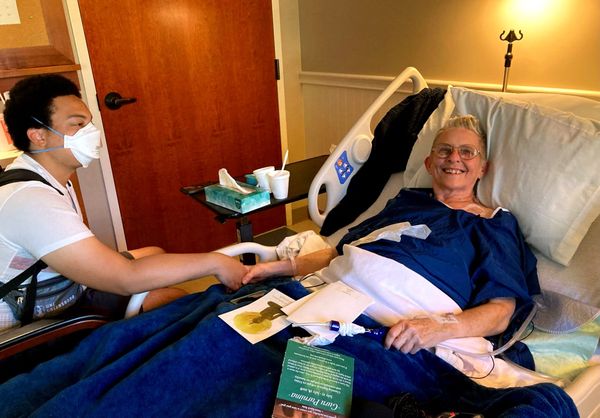
A couple days later, Brooke had a terrible pain in her gut and went to the hospital. It was diagnosed as diverticulitis (a serious intestinal infection) and a bowel obstruction. It could be repaired with a surgery that would leave her with a plastic bag attached to her belly, where her intestines would empty into the bag. Her son Adam flew in to care for her, and everything was moving forward until the morning of the surgery, when Brooke declared she didn’t want to go through with it after all.
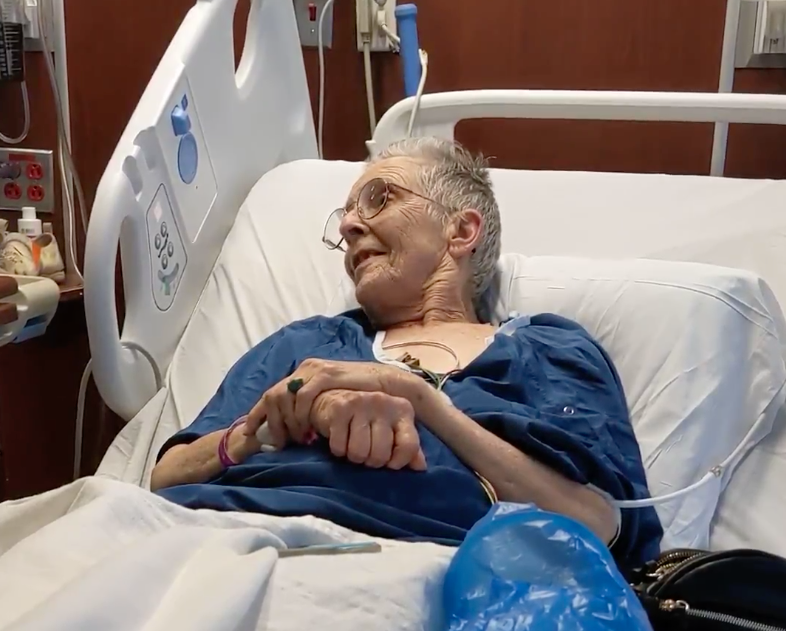
While she sat in the hospital bed with an NG tube coming out of her nose (Nasogastric tube for stomach suctioning), Adam recorded her conversation with a surgeon and other members of the medical team.
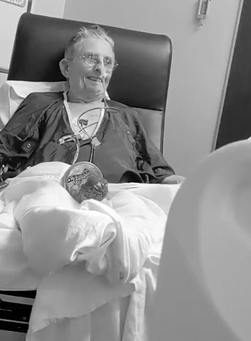
Brooke: I know that without treatment I'm going to die. And I've always thought that at some point in my life I would decide to just not be treated. And that's what I've done. I have had a complete life. It hasn't all been happy, but it has been complete. But I don't want the NG tube.
Surgeon: Can I back up for just a second? Because I think we skipped to the main headline here, which is that you don't want the surgery. And I heard that from your nurse, but I just want to understand a little bit more about your thinking with that. Because I hear you on the AFib, I hear you on the NG tube, I hear you on all this stuff that maybe it's not really making you feel better and it's all these medicines and all this stuff we're doing. And I totally hear you on that. I want to understand the surgery.
B: If I start down the surgery chute, I am looking at a long, long, iffy recovery. We haven't even talked about the ileitis. That's there too. So then it's the pacemaker. And the end result of that is not going to be independence.
S: In which way?
B: The end result of all of this healing and rehab. It's going to be a very medically involved life.
S: I see.
B: And I don't want that. I want to have enough time to say goodbye to my friends and my family and be off.
S: That is completely understandable. Actually, you know what, here's what I wonder, if you guys don't mind. I'm rounding with the whole team right now, and I feel like this is an involved conversation that I want to take all the time that we need for. Do you mind if we come back later and chat about this, maybe in the afternoon? And maybe we could even arrange that I could be with the palliative care team when we come back and talk to you.
[Brooke agrees]
S: Then in that case, what can we do for you in the meantime?
B: Oh, you can take this damn tube out.
S: I will tell you, you know, like looking at that canister over there.
B: Yeah.
S: Right. That's all stuff that came out of your stomach.
B: Yeah. Yeah. It came out of my stomach in the last three or four days.
S: Yeah. And that stuff that probably won't be passing through. So the main concern I have with taking the tube out is you may start throwing up.
B: Yeah.
S: OK.
B: You know, again, I'm going to go home and throw up a lot. I'm worried about that. We can take it out for right now and see how you do with it out.
S: I mean, that's fine.
B: Yeah. It's a kind of a trial.
S: Yeah, exactly. Trial run. Let's see how you do without it.
B: Is there anything to do about gas? It's like I came in here wearing small, medium and now, now I'm nine months pregnant.
S: Yeah. You have an intestine baby in there.
B: It's just full of gas. It's not going through.
S: Yeah. I don't have a whole lot that I can do about that right now. I will say the NG tube may be helping slightly with that, but not much.
B: And I'm not going to do anything by mouth. I'm really not. Yeah. Yeah. This is it. Ice.
Psychologist: Can I ask one? Can I ask one question?
Surgeon: Oh, yeah. Yes.
Psychologist: I won't be here this afternoon. I'm curious. Is this the mom you know?
Adam: It absolutely is. She is 100 percent herself.
Brooke: Is she nuts or what?
Psychologist: No, you sound clear as a bell.
Surgeon: Yeah. Dr. Bob is actually a psychologist who works on our team.
Brooke: Oh, I'm a psychologist.
Surgeon: I know exactly. This is the one I was referring to.
Psychologist: Oh, well, nice to meet you. I thought you sounded brilliant.
Adam: Her litany for years has been that she does not want to live past her expiration date, and she meant it.
Brooke: Yeah. Do not keep me past my use-by date.
Surgeon: We don't want you spoiling.
B: And I'm getting there.
S: We don't want you spoiling on the shelf.
B: I have started to turn moldy in the back of the refrigerator.
S: I hear you. I'll come back around later. I'll try to coordinate with the palliative care team and see what we can work out.
B: Nice to meet you.
Psychologist: Nice to meet you, too. I'm Dr. Bob.
B: You're wonderful.
Surgeon: We'll be in touch.
B: Thank you for doing this.
Surgeon: Oh, of course. Yeah. Happy to do it. We'll see you later.
Brooke: Bye-bye.
——
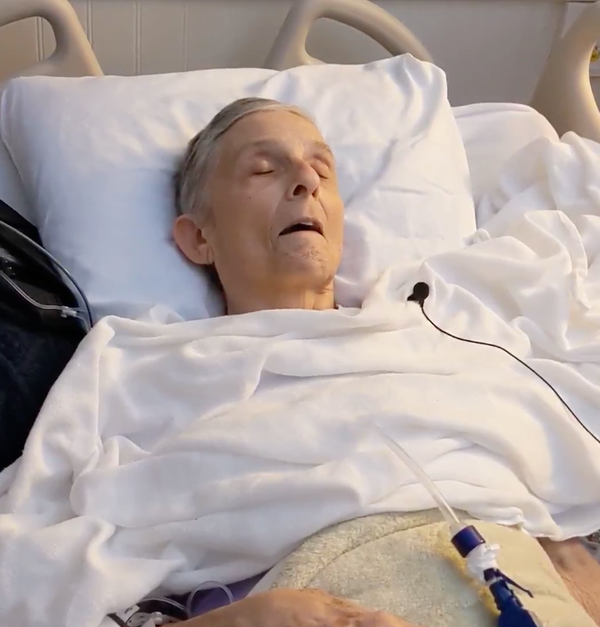
Hours later, Brooke had another conversation with the surgeon, plus a member of the hospital’s palliative team. Adam shot a video of this conversation as well, and an image from the video is at the start of this post, no longer with an NG-tube.
In the video, Brooke gives some backstory and reiterates her position on refusing the surgery, naming how it won’t resolve her heart issues or her diabetes (or her respiratory issues), and how the event would be “a big step down” in her health.
“I mean,” she says, “I've been watching myself die. My neuropathy, which is just numbness, kind of crawls up my leg, and I'm thinking, ‘Well, there, I'm letting go of a little bit more.’ I'm just dying by inches. And that's okay. But to be good and sick seems more like an opportunity than a crisis.”
The surgeon mentions that hospice at home may be an option, or she could go to a hospice Inpatient Unit. At that, she thanks them, and the conversation is over.