Encounter with an Ancestor: Janet Schaefer

Share
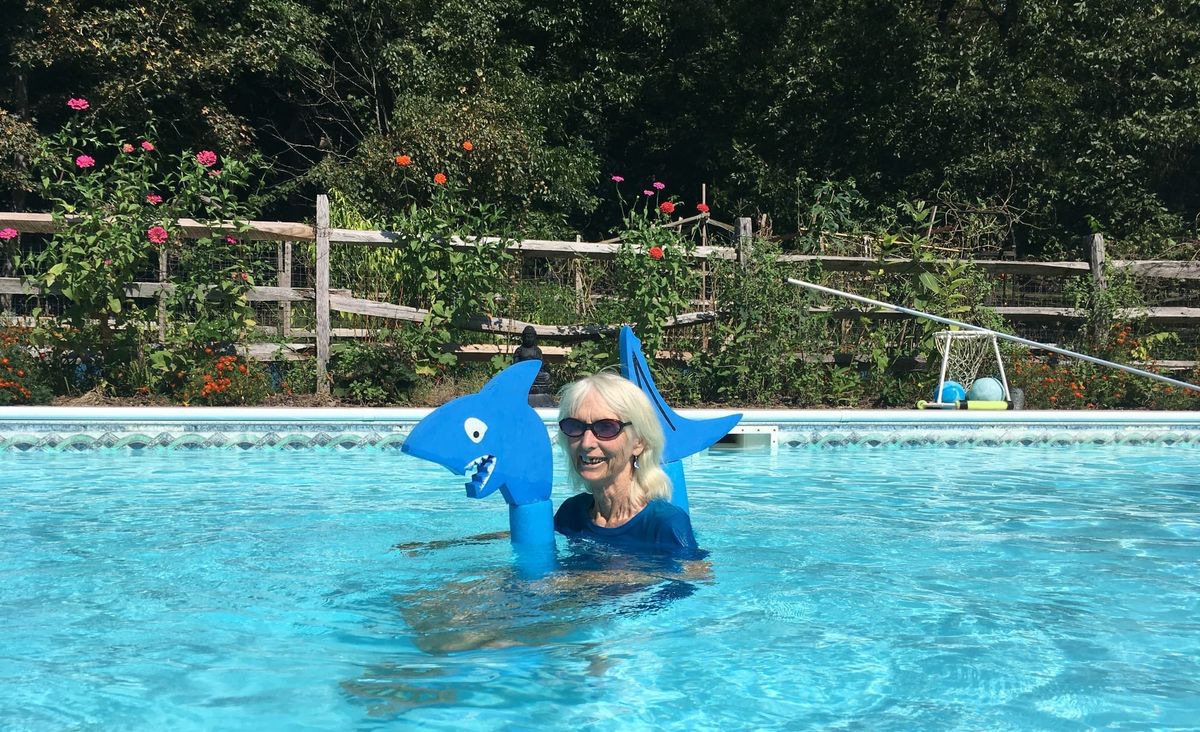
Janet is in a pool, wearing a blue t-shirt and floating with a foam shark. Her smile reveals her missing front tooth, and her bluejay earring matches the image's color palette
Janet in Blue

This is the third story in a series. The first introduces Janet's friend Brooke, and the second documents an evening of conversation between Janet and Brooke and others. Readers are welcome to start where they please, including here:

Janet loved to tell the story of returning from a meditation retreat, when strangers approached her like never before, wondering about her energy, and a deer even walked up to her out of the woods. Even when she wasn't glowing with that post-retreat aura, though, Janet had a welcoming vibe that made people feel safe around her. Made me feel safe around her.

I shared previously that Janet was one of my first friends in Greensboro, and that she introduced me to Brooke, my neighbor who changed my life. Janet had a playful spirit and she approached progressive memory loss with an enlightened acceptance. She lived art, painting all the cabinetry in her house with blue background and bright fishes, so that it looked like a big aquarium, each shape made in the simplest possible form.

With Janet’s passing on April 7 of this year, it feels appropriate to focus our attention on her, with warmth, as her spirit navigates the bardo. Next month we can return our attention to Brooke.

2025

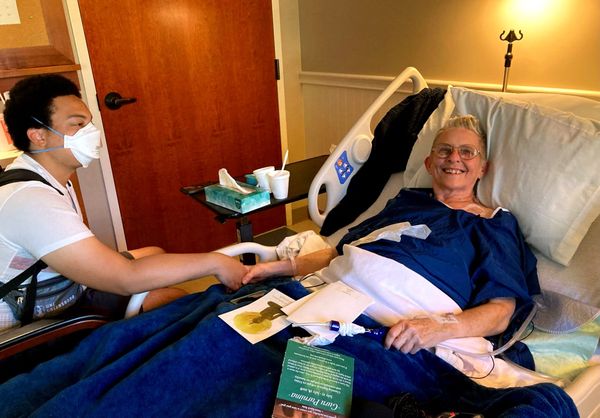
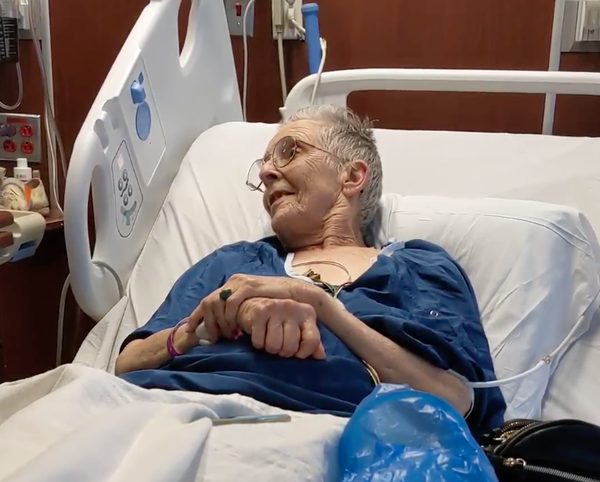
After a decade of steady decline with dementia, Janet had a fall on Christmas Day, and she spent the next couple days in the ICU. Her husband Eric texted me from the hospital, and I came over to visit the room she’d moved into there, after making it out of the ICU. She was disoriented, asking about her cats, forgetting their names, telling me about a painting on the wall that wasn’t on the wall. She still remembered me, which was a comfort and a relief. 

I asked Eric how he was doing; he told me how their dog, PopPop, mourned every time he left the house, and how Janet mourned every time he left her side. Splitting life between home and hospital was wearing on him. 

After her condition had plateaued, Eric took Janet home. The hospital still had tests and therapy lined up, but it was a Friday, so therapy wouldn’t be happening until Monday, with far-from-guaranteed results, and after several days of tests, it was already becoming evident that no one was going to be able to tell him why she fell. She wanted to see those cats, and Eric made it happen. 

The next day when I saw Janet, I was shocked to see her get up out of the bed and walk to the bathroom unassisted. Their home was such a warm contrast to the sterility of the hospital, with carpeting and animals and art all over the walls, Janet’s and others’.

She was much more oriented, too, engaging me in conversation about a book filled with cat pictures. She asked where I lived, forgetting that she’d been to my house, and when I told her, she asked if I ever met Brooke who lived nearby. I took delight in telling her the story of my connection to Brooke, which started with Janet introducing the two of us, and she was fully engaged in listening. There’s something really special about the in-the-moment-ness of dementia, similar to how some kids love to hear the same story over and over. 

During Janet’s week in the hospital, no one had brought up hospice or palliative, even though several things about Janet’s case made her a clear candidate: low weight, unexplained falls, recent hospitalization, history of cancer, dementia. I made a phone call to a friend in the admissions department of the hospice I used to work for, crying over the phone while I described her situation. 

It turned out that Janet’s address was outside of that hospice’s range, so I did a bit of research to find a well-rated nonprofit hospice nearby. I made the call, with Eric’s consent, and set up a visit for Monday morning. I described to him how the visit didn’t mean that Janet would be admitted to hospice, and that the primary purpose was informational. He seemed open either way.

I was not surprised to hear that Janet was admitted to hospice. Her twice-weekly visits from a CNA (Certified Nursing Assistant) to bathe her were a welcome level of care, even if slightly embarrassing to Janet. When Eric expressed his gratitude for the care he was receiving from them, I felt proud to have played a role in making that connection.

On my next visit, later that week, Eric and Janet and I took a walk outside, all the way to the creek, and I wondered whether Janet would recover enough to “graduate” from hospice, where a patient‘s prognosis becomes longer than 6 months (yay) and the patient is no longer eligible for services (not yay). We walked by the lotus ponds that Eric had built out of bathtubs. In recent years, Janet had become obsessed with the lotuses, but today she didn’t mention them. When I asked how to plant the seeds she’d given me, Eric stepped in to describe the steps, scraping the shell down to the white part, then putting them in water and refreshing the water daily until they sprout, then into the pond. 

Over the next few months, I checked in with Eric periodically over phone or text; things sounded relatively stable. Then one day in April, Eric texted, saying that Janet’s condition had declined, and she was almost unresponsive. Taking liquid morphine and basically nothing else. I told him I’d visit the next morning, or that I could visit that night if he wanted. “We’ll see you in the morning,” he said. 

After going back and forth with myself about whether to ask Eric about timing, I decided to just pick a time, late morning, and tell him when I had an ETA, “about 40 minutes away.” Pop Pop didn’t bark at me when I parked the car and approached the house, the first time that had ever happened. 

I let myself into the house, saying “knock knock,” and walked to their bedroom where Janet was on the bed, Eric also in the bed with his arm around her, Janet’s Brother Robert making small talk, and Pop Pop got up from the floor to come greet me, still without barking. 

“He’s wagging his tail, happy to see you,” said Eric, while I rubbed Pop Pop’s cheeks and shoulders.

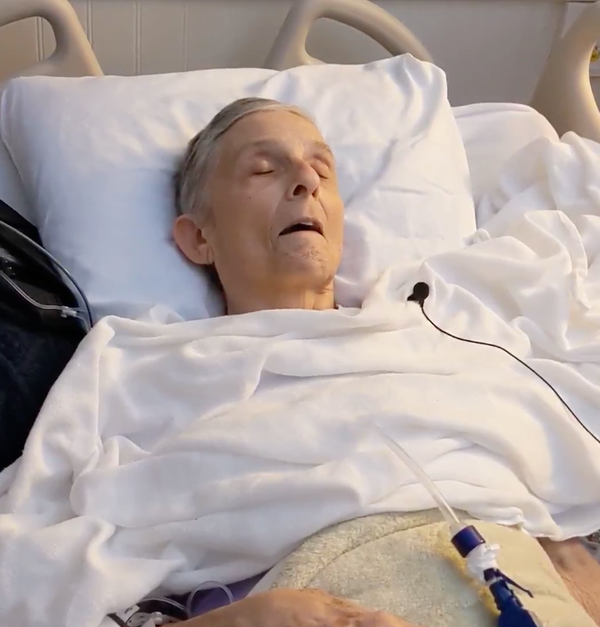
Janet was struggling to breathe, short gaspy breaths that reminded me of a term that one of my nursing school friends had learned as an EMT, “guppy breathing.” I still don’t know for sure whether this was the “death rattle,” but it was clear that Janet was dying. 

“She’s been like this since last night,” Eric said, out of the bed and on his feet. He noted that she’d been able to speak a bit yesterday during the day. The hospice nurse visited, adding Atropene drops to her chart, to help dry up the secretions that were making it harder for her to breathe.

“Is the oxygen machine doing her any good,” I asked the nurse, repeating the question that Eric had asked me, “he wanted to know if it was prolonging her suffering.” I’d already given my answer, but since I wasn’t her nurse and since I’ve been away from hospice for a year, I was interested in hearing the nurse’s answer. 

She said that no, it wouldn’t prolong her life, that it may help with comfort by decreasing her air hunger.

Janet was working so hard, really in it. At that stage, an indicator of pain is when the patient scrunches the skin between their eyes, and hers was slightly scrunched. The hospice nurse recommended an additional dose of morphine before leaving.

I moved the oxygen concentrator into the bathroom, since the tubing could reach, so that it wouldn’t be quite so loud. It tends to feel hard to know what to say or do during situations like this, and I always feel proud of myself when I can think of how to be useful and not in-the-way. I couldn’t tell whether Eric cared about the noise from the concentrator. The fact that it made me a little more comfortable helped me imagine that maybe it made Janet more comfortable as well. Quito the cat joined her on the bed.

I sat next to her and spoke a version the lovingkindness meditation that had meant much to her: “May you be filled with lovingkindness. May you be peaceful and at ease. May you be happy. May you be well.” 

Several friends visited: 
Vance with the long beard took a picture of the scene. “I’ll see you tomorrow,” he told Janet before leaving with his big dog. 
Joni brought an apple pastry that she baked, insisting that it was no big deal. 
Kathi gave me a big hug, and we both cried. 

I started to make my exit by saying goodbye to Eric, who was back in the bed by that time, then to Joni who was standing next to Janet and holding her hand. “Have a safe trip,” Eric said to me, and when Joni asked “Where are you going,” we chatted briefly about Quakers, since I was on my way to a Quaker event. 

I started to turn toward the door, then immediately turned back, “Goodbye Janet,” I said, and when I bent over and kissed her forehead, I noticed that her eyes were more open than they’d been previously.

“She’s stopped breathing,” said Joni. 

“I think that’s it,” Eric said, and he put his head next to hers and wept. 

I stood frozen while Janet made several more attempts to breathe, short sequences of air getting blocked by the secretions that had gathered in her throat. Until now, she’d been able to pull just a little air past that point. 

My nurse training kicked in. It looked like aspiration, and I considered what could be done to clear the airway, turning her to the side or chest thrusts would both make sense for some dying folks, but not Janet, not in this space and time. 

I considered how if she’d gotten the atropene drops sooner, it might have extended her life by another day or two. I considered the ways in which my goodbye could have influenced the moment of Janet’s departure, a moment of intense connection. 

Though I'd encountered plenty of dead and dying patients, this was my first time witnessing the moment of death face to face.

As her urges to breathe stopped, the color faded from Janet’s hands and lips. 

Eric howled, crying with his head next to hers. 

Quito stayed curled on the bed next to Eric. 

PopPop stayed curled up on the floor. 

Eric’s phone rang, classical music with triumphant clashing cymbals. It interrupted his tears, but none of us moved. It rang again. None of us moved.

The moment’s gravity sealed us. 

Dogwood blossoms filled the trees outside. 

Butterflies flitted among an azalea’s pink blooms. 

Janet’s brother Robert came in and sat on a piece of furniture near the foot of the bed. 

Kathi came back from where she’d been, outside taking a call. She sat on the swinging bench, in the same screened-in porch where She and Janet and Brooke and Eric and I had all sat together four-and-a-half years ago, talking about what songs folks wanted to have played at our funerals. Janet's was "She'll be coming around the mountain."

I made another motion toward goodbye, about half an hour after my previous goodbye. Eric, still in the bed, reached out over Janet’s body. He and I grasped eachother’s forearms, and he said he was grateful I could be there. I cried while saying this was one of the great honors of my life. I thanked Janet, my body's attention toward her body, my mind's attention toward her presence everywhere. 

I sat next to Kathi on the porch, and she and I embraced and cried again. She wondered at Janet’s art, so much of it. “I’ve never even seen that piece before.” She walked toward a painting of a yellow dog or cat, floating in blue space, surrounded by stars and fish.