Present Time: Giving Notice

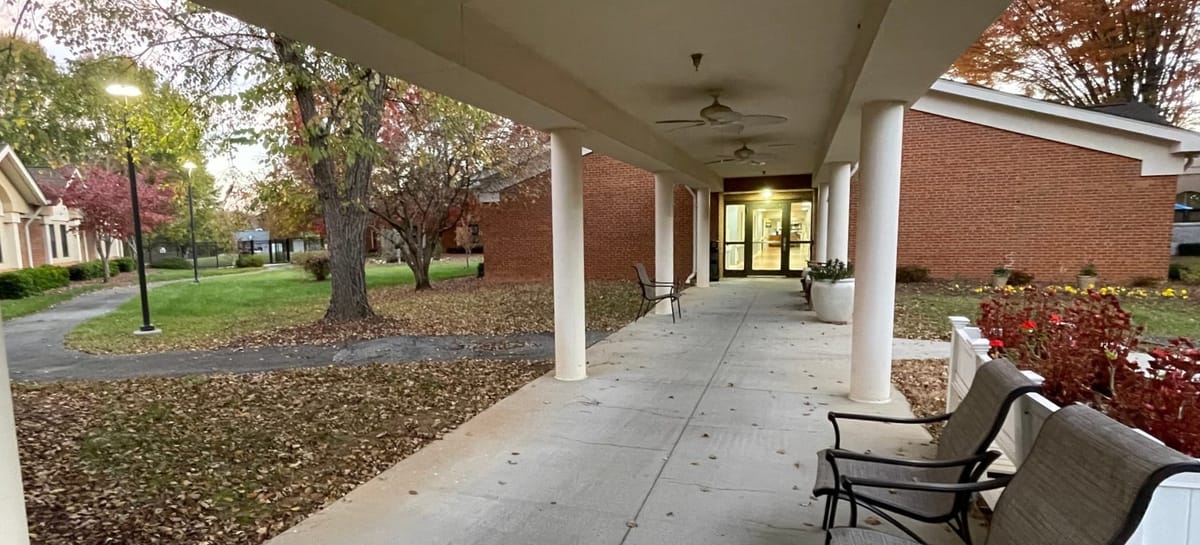
For the last six months, I’ve worked for a Skilled Nursing Facility, managing medications and miscellaneous other tasks for sixteen residents at a time.
It’s not unusual for a single resident to demand constant attention. I can think of six residents who would appreciate all-day accompaniment, some of whom are often saying “Help Help Help,” or “Come here I want to tell you something,” or recently “Will!”
I’m able to get to them eventually, but I can offer so little of what they really want, which is my time. In some cases, a family member will come to sit with a resident, which is a godsend to the staff and the resident. It hurts to have a job that requires me to focus on the material world of pills, eye drops, lidocaine patches, wound care, blood pressure, insulin injections, etc, when many residents’ most acute suffering is loneliness.
Since starting this job, I've been plagued with the challenge of finishing all of my tasks within the hours of a shift. During a big meeting, I told the Director of Clinical Services, “We are stretched thin,” speaking about the Certified Nursing Assistants as well as the nurses. Another nurse in the room nodded. “If we could have one more nurse, or one more CNA,” I said, making the case that we could do better with more staff.
The Director of Clinical Services thought about it for a moment, running the numbers in her head. No, she said, that isn’t correct. She cited a time when she was the nurse for 24 patients at one time, and she was still able to do a good job at the little things, like putting out treats every afternoon.
Her response has been echoed by people at the level of hierarchy between her and me, one of whom has said to me twice, “I don’t see any reason why you shouldn’t be able to get your tasks done.”
As a result of my speaking up, they sent me to training at an affiliated SNF, with higher ceilings and more elaborate trim carpentry. Each CNA worked with roughly 5-to-8 residents, compared to 7-to-12 at the SNF where I'd been working. The nurse I shadowed was supported by a Med Tech who handled passing medications, my most time-consuming task, which allowed the nurse to focus on all the other things, like prescriptions, reports, treatments, and handling any situations that arise. While this training was a breath of fresh air, it did little to improve my challenge with being able to finish my tasks on time.
I have one resident who often says, “I’m in pain, it’s just excruciating, what can I do?” and I rub Voltaren Gel into her knee that’s always in pain, crouching down so I can look her in the eyes and tell her I’m sorry she’s in pain. That sounds really hard.
It’s an interaction we’ve rehearsed a dozen times in various ways, sometimes with detours into the related darkness of her thoughts, “You think I’m pathetic, don’t you?” she’ll say.
I don’t think she’s pathetic at all, and I tell her so. It breaks my heart how this vision of herself keeps coming back, and I’m scared that one day I will think of her as pathetic, and she’ll catch me thinking it.
As I rub the gel into her knee, I think about how it absorbs into her skin, getting to the inflammation through osmosis, some of it surely traveling around in her bloodstream, not nearly as much as the oral medicines. Diclofenac Sodium Gel. It kicks in quickly enough that the therapists will sometimes give me a heads-up before they’re about to work with a resident. Putting it on 15 or 30 minutes beforehand seems to be plenty to reduce the resident’s pain during therapy, and it sometimes lasts for hours.
I’m aware that nursing homes are typically miserable places, that our healthcare system is broken, that our society is collapsing, and that many nurses work 12 hour shifts that are much more demanding than what I’m doing. I need to be grateful to work in a facility that does not constantly venture into unsafe territory. And I am.
I love that I’m on my feet the whole shift, often walking more than half of the day’s recommended steps. Walking for pay is a dream job. Instead of looking at screens all day, I get to hold folks' hands and look them in the eyes. This is good for me!
On some days, I am able to finish all of my tasks by the shift's end, 3pm, give report to the next nurse, go home and take a shower and a nap, and then be awake and alert by 5, ready for the evening. I pour myself into work for those eight+ hours, 6:45AM to 3:15PM, and by the time I get home, I am dead tired in a way that reminds me of how I would feel after a good game of soccer or ultimate frisbee. There’s a value in that kind of exertion, like exhaling completely before taking a deep breath in.
This place also makes lunches that are delicious and affordable, a serious perk. A large cookie for $1.25, a personal pizza for $5, a generous salad for $3, a smoothie for $2.50. I’ve gained weight at this job, which is saying a lot.
One of the biggest things they teach you in nursing school, the one thing that the licensing exam screens for most of all, is the ability to practice safely, not to cause harm, “just don’t kill anybody,” they say, joking-not-joking, because this work is dangerous.
When I work past 3pm, I'm often tired and thinking of home during that time, and my focus is not as strong. This tends to happen on more complex days, and as things get more complex, they get more dangerous. Someone has fallen on the floor? That’s the time to become extra alert, extra cautious, extra careful.
My work has teetered on being unsafe, in a way that is not just outside of my comfort zone but also outside of the limits of what I am willing to tolerate. If it usually takes me more than a shift’s worth of time to do a shift’s worth of work, what am I supposed to do on a day that goes sideways? I don’t want to be there when it happens.
Within the organization, there’s a cultural practice where when something goes wrong, blame falls on the lowest-possible ranking staff person, then a message goes out to all staff, “don’t do this.”
I don’t blame the managers for this, nor do I blame the executives. The larger system within which we’re operating, where executives have both permission and incentive to stretch working staff as thin as possible, that’s our disease to heal, for everyone’s sake. Administrators' numbness can be tied to the numbness of working staff who, having too much else to do, ignore a resident saying “help” for any amount of time. The entire system is ill.
I was drafting a message to the Director of Clinical Services about the need for change within our organization, and the words would not come out. Everything felt like a repeat of things I’d already shared. I decided to draft a message of two-weeks’ notice instead, to see how it would feel, and the words flowed out.
The next morning was my day off, and I was so ready to send it in that instead of getting up and getting dressed, I grabbed my phone off the charger and brought it back into bed with me, revising with my thumbs the message I’d drafted the previous night, then sending it.
“GM…” the response started (including the “...”). I considered that it wasn’t yet 7am. Oh well. It was done. I sent an email to the scheduler, then I went to sleep and had the nicest hour of dreaming.
I haven't quit my job altogether, but shifted to "as-needed" status, where I can choose which facility to work in. As of today, I'm required to work at least one shift per month. I still have some hope that things within this facility might shift, and that my stepping away might help contribute to such a change. Stepping away has certainly helped me to see this issue more clearly, as has the process of writing about it. What's ahead for me is less clear, in a way that feels equal parts scary and invigorating.
In addition to increasing staffing and increasing compensation for direct-care staff, I'll offer another avenue of possible improvement to the organization I'm still tied to, and to similar organizations, one that doesn't cost any money to initiate.
There's an open secret among folks who look at computers for most of the day for their jobs: it's not unusual for someone to spend the majority of a day off-task, and for some folks to spend entire workdays off-task. Having lived much of my adult life in Silicon Valley, I have intimate knowledge of how our technological devices are designed to distract our attention, and I would be very surprised if the folks who work desk jobs do not long for more control over their attention, and for more off-screen human connection.
This avenue toward improvement for the staff who look at screens and sit in meetings: step away from your desk and visit with one new Skilled Nursing resident per week. Hold their hand. Look them in the eye. Have a seat, if they welcome it. A sit could change their whole day, your whole day, and more. Direct Human encounters can include the stuff of life, and there's no need for the direct-care workers to have exclusive access.
Fostering closer relationships between administrative staff and residents could ameliorate staff loads, in small ways and large, and this is my wish for you, for the residents, and for our broken society.