Encounter with an Ancestor: Mickey Muennig

While mushroom hunting with friends in the Berkeley Hills, I got a call from my neighbor Misha. Her father, whom I had met briefly at his epic homestead on the California Coast, needed to sell a house he owned in Mexico, and the related taxes were significant enough that attempting the sale from a distance would cost far more than flying there and signing paperwork in-person. He could not make the journey alone, and she could not accompany him.
My phone to my ear, I stood on a little boulder, looking out over a grassy valley dotted with wildflower blossoms, when she made the pitch: could I accompany her father to Mexico for a week? She offered a hundred dollars per day, plus food and lodging.
I had just started taking microbiology at Berkeley City College. A step toward nursing school, this was my first college class since graduating from Stanford nearly a decade earlier. It was going well, and I didn’t know the implications of checking out for an entire week.
“I don’t know who else I could call,” she said. Her dad’s isolation—made more extreme by a bridge outage blocking the main road into Big Sur—limited the pool of people that he might be comfortable traveling with.
Mickey had designed the baths of the Esalen Institute, a concrete structure designed to facilitate a life-altering hot springs experience, after an earthquake or a landslide had destroyed the previous baths. He was Big Sur's go-to architect for a stretch of his career, and his own house was a painter's brush stroke on the coastline's beauty.
I had met him during a visit to Big Sur where I also helped Misha maintain the house she designed and built on his land. The whole estate supported a well-crafted life that included lots of time alone with the view. During the later stages of adulthood, it gets harder to manage that level of isolation. International travel: also harder to manage.
At that point, I had worked all of one single night as a paid caregiver. This was a once in a lifetime opportunity. I gave a tentative "yes." Woohoo! What would I do for a week in Mexico with a man that I barely knew?
We flew first class, which was nice because Mickey moved so… very… slowly. So after I wheeled him down the jetbridge to the plane, he was able to get to his seat in the plane’s first handful of rows without delaying too many passengers behind us. Also, first class is nice just because it’s first class! We drank margaritas, and the flight went by quickly.
It didn’t make sense to stay at Mickey’s house, since no one had been living in it and it would’ve taken too much effort to get the utilities turned on to wake the house back up again for a short time. The house that Misha rented for us had a walled-in back yard and pool that I used a few times. Mickey slept downstairs and I slept upstairs. It had a restaurant around the corner where we ate breakfast on many of the days we were there, with the biggest Bird of Paradise I have ever seen, and it was easy enough for me to make grocery or supply runs at the local market.
I was “on duty” for about twelve hours a day, and “on call” for the other twelve, during which time Mickey would be alone, mostly in bed, sometimes sitting or getting ready for bed, slow, slow, slow. It felt important and necessary for both of us to have time to ourselves.
I held Mickey’s hand often, inspired by the Nepalese caregiver I’d met through John Perry Barlow, and I often would rub his shoulders or neck. Holding hands also provided stability, when we walked, in addition to the connection. It felt good to me, as well, to have that connection.
On most days we got breakfast at the restaurant, ordering tacos in their courtyard. While we waited for the food, I performed my tasks of getting Mickey’s medications out of the pill planner that Misha had pre-filled for us, setting them on a napkin for Mickey to take, just like I’d seen my grandparents do for themselves many times. I checked his blood sugar with his little glucometer, then I recorded the glucose level.
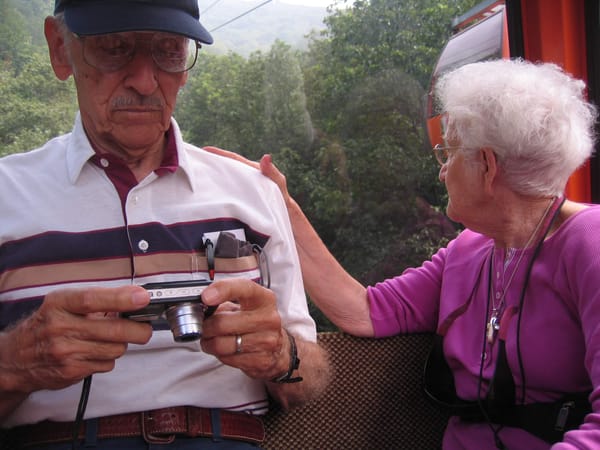
At the house, we mostly sat around. At moments, we engaged in improv-style silliness, pretending to make calls to strangers on the house phone. It felt good to laugh about the absurdity of these two men, ages thirty-three and eighty-three, barely met each other, spending all day together. I had a sense that our angels were looking out for us. Things went smoothly, for the most part.
One night, we went out drinking, chatting in Spanglish with the people at the table next to us. Mickey had one margarita too many, which is partially my responsiblity. I hadn't reckoned that he would be willing to take risks for himself where I needed to act as the guard rail. Whoops. At least it was fun.
“How are you doing Mickey?” I asked from the open door of the bathroom, after we’d Uber’ed home.
“Not too good,” he responded.
New to cleaning up poop, I was relieved when it did not feel like a big deal, just another aspect of this absurd adventure.
The next morning, we had our big meeting with the folks from the immigration office, and I barely had Mickey dressed and ready on time. Misha flew down a couple days later to join us, and we all got an Uber up to the Gulf Coast together, less beautiful than the Caribbean to the East, but also much less crowded. There we drank beer by the water and celebrated the fact that the trip had gone as planned, papers signed.
Misha stayed in Mexico for a little while longer, and I flew back (economy class) and got back to class.
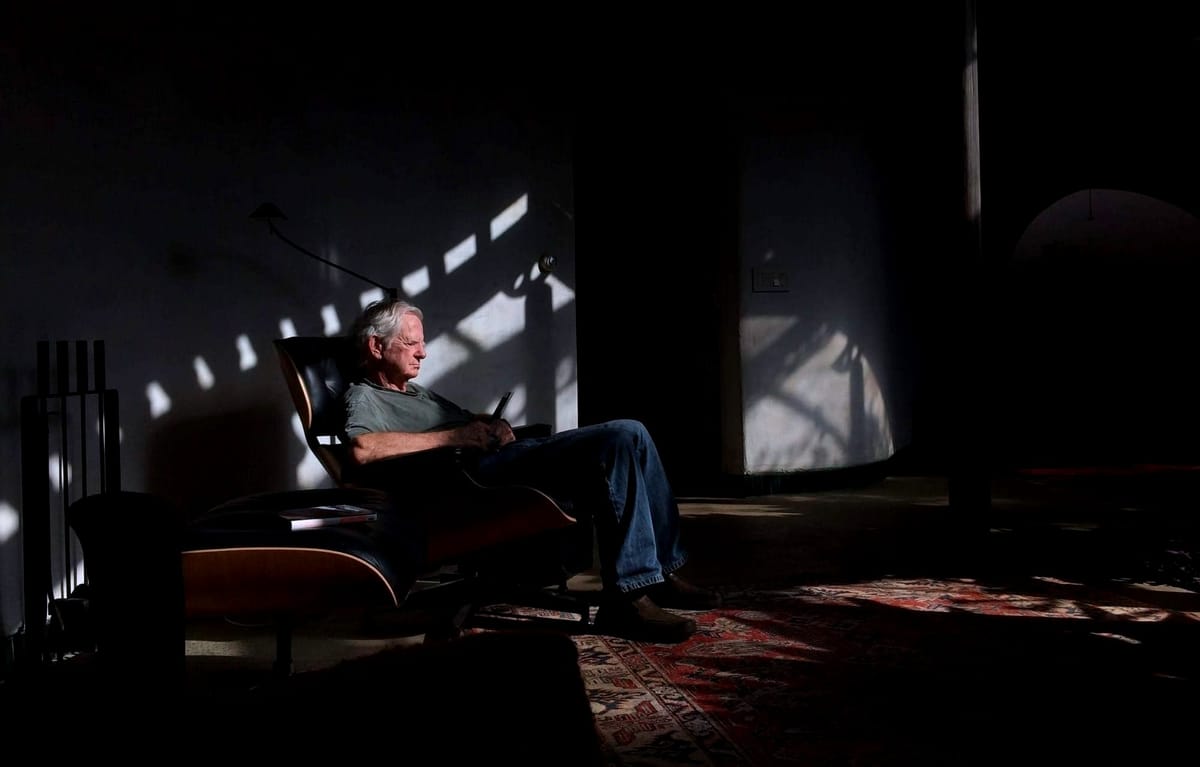
I did a couple more stints of caregiving with Mickey after that, at his legendary house on the coast. Often he would sit for hours at a time, no book, no music, no television, with his big black dog Habiba lounging nearby.
“What are you thinking about Mickey?” I’d ask.
He’d turn his head and consider the question for a moment, then turn back and shrug, “nothing!”
He loved going out to the restaurants with me, especially a place called Nepenthe, Big Sur’s most affordable place to gather with a crowd to watch the town’s world class sunsets. All the locals in Big Sur knew Mickey.
When we’d already been to what seemed like every restaurant in town, it was time to visit the fancy hotel he’d designed, the Post Ranch Inn. With rooms starting at around $900 per night, the Post Ranch Inn’s restaurant is not open to outside visitors. The woman at the gate recognized Mickey immediately, though, and radio’ed someone on her walkie talkie to get approval for us to come in for a glass of wine.
Walking down a curving ramp toward our table, we passed a large window that looked down into the kitchen, bustling with workers in white, then down to the level where all of the tables were seated with the restaurant's other patrons, all of them hotel guests, except for one small table for me and Mickey, near the wine racks. The menu featured some of the most expensive wines I have ever seen, and our two glasses cost $55. The windows onto the ocean were massive, and with the steepness of Big Sur’s hills, the ocean views are like looking over infinite wave patterns from a skyscraper. I could stare at that water for hours.
Mickey gestured to one of the largest windows and told me about how when it was installed, there was a large handprint on the inside of the double-pane glass. He had insisted that they take the time to reinstall it, cleaning the handprint. He felt immensely proud of this work while also sad that he didn't fit in there, as a matter of social stratification.
“I didn’t think it would be a success,” he said with a shrug. “I thought, ‘nobody is going to be able to pay that much.’” It opened in 1992, and the world economy since then has stretched out in such a way that while most folks have felt poorer and poorer, there’s been a simultaneous increase in the number of people who can afford to pay thousands of dollars for a weekend hotel.
When the sun approached the horizon, the whole restaurant went quiet, everyone watching. Mickey and I didn’t have a great view of it from the table where they’d seated us, so I stood up and walked over to the ramp where we’d entered, with one of the waiters standing next to me, as the sun’s disc touched the water, dipping deeper and then disappearing.
“I guess you’re used to this, working here?” I asked him.
“Every night is different,” he said, with a look of awe on his face.
When it came time to pay the bill, Mickey moved even slower than usual, standing up out of his seat to pull out his thick bifold wallet. I resisted about four different urges to interject and offer to pay, thinking maybe that’s what he had in mind, why he was moving so slowly. Another thought passed simultaneously, wondering if the hotel might pick up the bill. They didn’t.
As he approached his need for care kept increasing, Big Sur became less feasible as a place to stay. His kids eventually landed on the idea of moving him to Thailand, where they could afford much better care than in California. Mickey hesitated and then relented, under the pretense that he would be flying there just to check things out for himself. The epic journey, much more complex than the Mexico trip, was a one-way adventure. He ended up loving his life in Thailand and dying there after a couple of years.
The visits that he and I had made to Big Sur’s spots turned out to be his final visits to several of those places.
After he died, his house was quickly and quietly sold, and there’s no telling whether its new owners have maintained some of its architectural wonders. I feel immensely grateful to have had the opportunity to spend any part of my life there with Mickey, during that era of the house’s existence, and during that era of his life.
Mickey showed me how a certain kind of life could be possible, and some piece of that life became contingent on my support and participation. A blessing to both of us.