Encounter with an Ancestor: Introducing Brooke

Recently this back-and-forth came to me, the two lines of which read like a poem:
How do we care for a dying generation?
One person at a time, kind of.
The generation is the Baby Boomers, the eldest of whom have reached their life expectancy. Herds of elephants in many different rooms, their approaching deaths are not slowing down, and yet…
Slow down we must: One person at a time across the threshold. I didn’t make up the rules. As a person’s care needs increase, they become the nucleus of a series of concentric layers of support. Some people have many layers, where the helpers are helped by helpers who are helped, in ever distant social spheres. Many people have thin layers of support, especially these days. The practice of caregiving is stubborn in its slowness. Hands-on care cannot be scaled up by technology business. Even as the dying person develops new bonds with caregivers, they eventually take the step from life into the next alone.
Kind of. As more people witness death, it requires less explaining to describe its potency for transformation. Through dying, a person can become more present in the lives of those they touched, like an exploding supernova. The practice of caregiving can increase one's capacity to offer meaningful care. Every individual’s death has the power to transform, and transformation spreads through contagion.
As a person who has been transformed by witnessing death, these stories are my two-part answer to the question.
How do we care for a dying generation?
One person at a time, kind of.
This next story, told over the course of six full moons, maybe more, is an invitation to slow down together, so that we all might better learn something from how Brooke Neal lived and died.
2021:
Brooke was COVID cautious, thanks to her COPD, heart conditions, and a respect for public health protocols, so I first got to know her online, through the neighborhood facebook group, a bustling community where a recurring theme is “gunshots or fireworks?” When I asked the group if I could borrow a cat to help me with a rodent issue, she commented, “I don’t think it works like that,” then she offered me some mouse traps she no longer needed.
In my second year of nursing school, I got an assignment to interview an elder about their life, a Life Review, and on the day that they handed out the assignment, I learned that Brooke was selling flowers. I stopped by her house to buy some of her flowers, and we sat on her porch and had our first real conversation.
We bonded over being from similar-sized cities in Texas. She told me about her mother, “an early Trophy Wife,” who killed herself with the Hemlock Society’s method, which, according to her, involved a plastic bag plus pills. She seemed completely cool, telling me the story, like it carried no trauma for her. When I said something indicating my own history with people killing themselves, she asked, “Who did you lose?” and I wept telling her about a friend from college, whose influence on my life I didn’t realize for over a decade, and whose death I don't expect to ever fully heal from.
"This is a Crying Welcome Space," she said, and as my tears streamed, it was easy to feel that she meant it.
During a lull in the conversation, I pitched Brooke the idea of the Life Review; she was keen. She loved conversation.
We would call our sessions “Wednesdays with Brooke,” named after the famous book Tuesdays with Morrie, on which the assignment was based, where the author interviews his dying mentor. Neither of us knew how soon she would be dying.
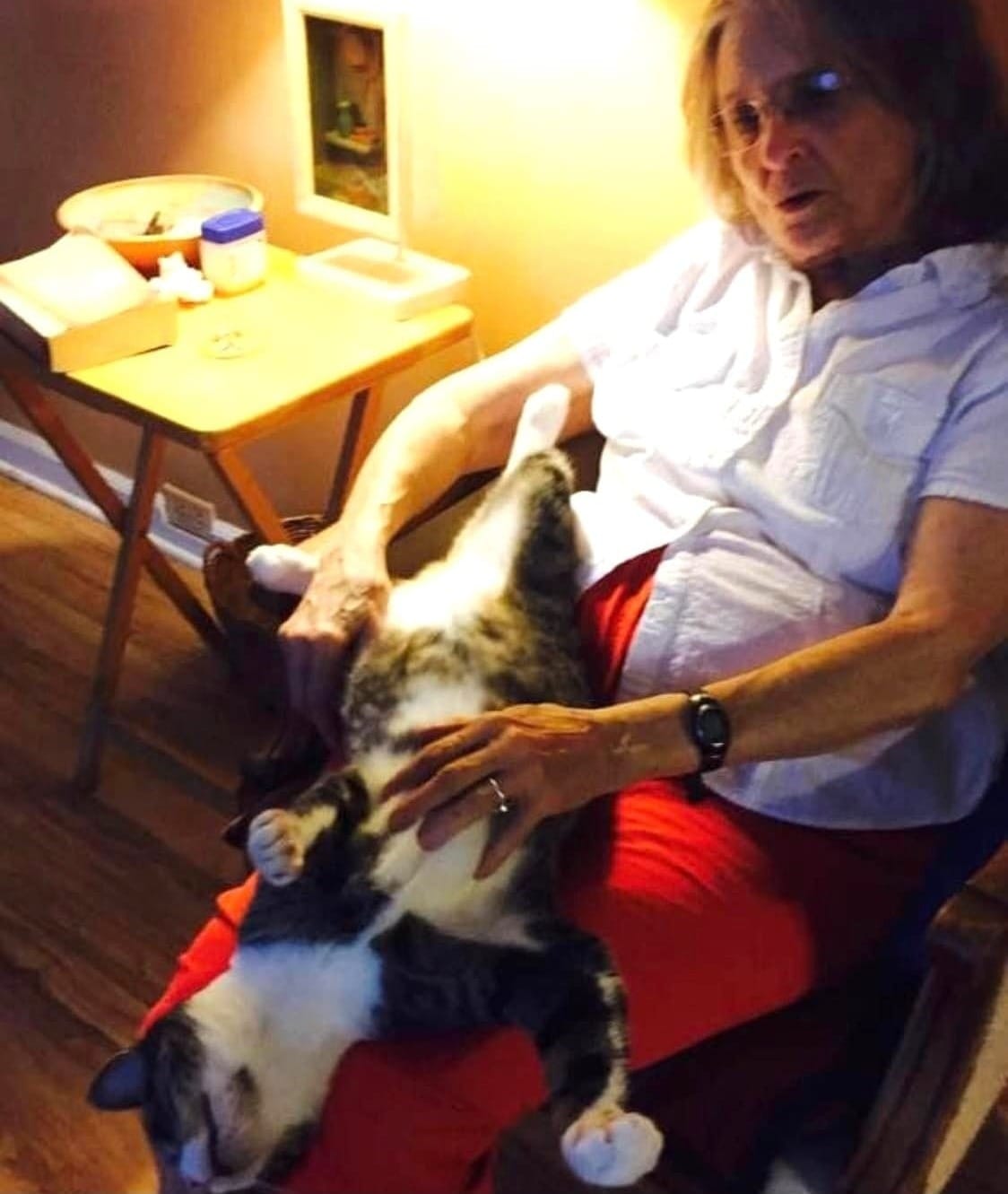
Our first official session happened the next week in the same space, her covered porch, with her seventeen-pound cat Sweetie Boy joining us at times. What follow are transcripts of the recordings I made of our sessions, edited for clarity and brevity.
My father, he was Boom or Bust, and he made and lost fortunes. Afterwards, he was very depressed. He finally wrote a book to get over it, and it was a book of the stories that he used to tell me when I'd go to bed. Like the Cold Nosed Ghost.
The Cold-Nosed Ghost
Have you ever smelled sour pinto beans? All ranches smelled like that. And whenever the whole family would leave, like to go to a dance or something, they'd have to leave one of the kids home to feed the animals and look after things. So they went on a Saturday night. Well, the beans had been cooked the Sunday before. And so it was pretty sure that he'd have a bellyache and need to go to the bathroom in the middle of the night. And it was a cold night. He was, you know, laying there in his little union suit, a one-piece underwear thing with a flap in the back.
They all told ghost stories, and somebody had told him something and kept him kind of scared. He was about nine or ten. And so he's thinking about it and thinking about it, and he finally decides to get up and go out to the outhouse. And he's creeping out there, you know, and he hears something behind him. And he's already got his pants unbuttoned because he's really in a hurry. He starts to run and he tripped. Something came up behind him and stuck its cold nose in his butt. And of course he scrambled into the outhouse and stayed there the rest of the night. But it was a dog.
So that was one of the bedtime stories I got as a child. Oh, there are more. There are more. It was a dog, but it was the cold-nosed ghost.
I never met either one of my grandfathers.
One of them was a squatter in the 1860s and 70s and 80s, in Texas. They were some of the very first trailer trash, because to squat on a piece of land, you had to live on it for a year. And it was a section, it was a square mile. He would live on a piece of land for a year and then he'd put his house on a wagon and pull the house to the next adjoining piece of land that he was going to squat on. You know, they had a mobile home. And my mother's father was a hard-drinking, hard-whipping, abusive, gambling, fighting, pot-smoking guy that my mother hated and laughed when he died and refused to attend his funeral. So no grandfathers.
But my grandmother on my father's side, I got to spend a summer around her one year when I was about ten. And what I remember about her is that she cussed like a sailor. And it was mainly at night when it was time to go to bed and she'd go around trying to blow out the lights. And of course they wouldn't blow out, and she'd stand there cussing and blowing. But other than that, she just rocked in her rocking chair and then went on a tear every night. But she didn't make that much of an impression.
My grandmother, the one that I actually was close to, my mother's mother, was a long-suffering Jehovah's Witness. She was very kind. She was what they called a Practical Nurse. And so she worked with old people and took a lot of abuse from their families too.
But of course her husband was abusive, and as soon as my mother got married to my daddy and had money and power, she yanked her mother out of that marriage and helped her get a divorce. And that was good for her. She took care of herself. She was a very sweet person. And I look like her now. At least this side of my face! This side seems to be holding its own!
She lived till she was in her 90s, gardened until the year before she died. And she was younger than my father. Because my father was 29 years older than my mother.
An early trophy wife. I was thinking about my mother today and thinking, you know, my final answer about her was she was not capable of loving anybody else. And you can say, well, she was a narcissist. She certainly had multiple personality disorders—not Multiple Personality—but they ran the gamut from histrionic to paranoid personality, mostly OCD, and that would break down into paranoid schizophrenia when she got stressed. So she was hospitalised a lot, and I was always told, oh, she's gone shopping, she's gone to Kansas City to go shopping. You know, she was one of those people with mental illness, and everybody in the family just says, “Oh, well, that's just Rachel.”
And I, you know, I can imagine that she had reason for not being able to love, that she remained on the bottom of Maslow's hierarchy all her life. I couldn't be around her after I grew up.
Classical starts playing on Brooke’s phone, then stops. That's Janet, and I'll call her back.
“Have you told her we're doing this yet?”
Yes, I was a little concerned that she might be jealous.
“I'll do it with her too. Honestly.”
Oh, yeah, well, she has good...good stories.
“Yeah.”
But she'd rather hear yours.
“Yeah, she's good at that.”
She interviews people. I just love watching her operate.
“She should come on a Wednesday too.”
She doesn't come. You know, Eric won't bring her, and she won't drive. And, you know, I'm sure that's good for her spiritually or something, but I couldn't do it. I was raised to sort of push my way along and do what I wanted to, and it never occurred to me that I couldn't. I always asked for my raises and got them.
“Where did you learn that?”
I think my daddy conferred upon me some white male privilege. And my sister too. He couldn't relate to his daughters except as… boys. I had horses and baseballs and baseball gloves and a rifle and got took coon hunting… He was a wonderful father. We'd look at the clouds and see pictures in the clouds, and I know a lot of my art comes from that. You know.
And when I was ten, all of a sudden I couldn't sit in Daddy's lap anymore. “You're too old.” He didn't know how to be with women, except sexually. I mean, he was just totally sexist. And so he just distanced. And I would have given anything to just not grow up.
My sister was a reporter for the West Texas Livestock Weekly, and I've got a picture I want to show you of her that was taken in the 30s, and she was wearing pants and boots. But she married, I think, seven or eight times.
I didn't get married that many times, but I had some times. I used to say I was a foot soldier in the sexual revolution. But I was in New York in 1960. And the whole world was There. So I did a lot. And I had a lot of fun, and got in a lot of trouble. I mean, I wasn't wearing a bra before anybody talked about it. And I'll show you a picture of me in the first grade in my very emphatically cowboy suit. I had just whooped a little boy's ass. We weren't mad at each other. We were playing. I used to let kids play like that. But I mean, we had been rolling in the dirt. And that was my first grade picture, and my mother hated it.
Let me see if I can find it right quick. Let's see. Where would that be? …
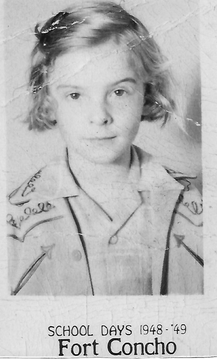
“Oh my gosh. Okay.”
That's me!
“What a spirit.”
Like, “Don't fuck with me.” Somebody was telling me she'd gotten a big dog and she felt safe. And I said, “I think I'm scarier than any dog.”
Brooke turns to Sweetie Boy, who is scratching his neck with a hind leg. It's time to put your flea medicine on...
So, um... I'm trying to think of interesting things in my childhood, but it was such a short childhood…
When I got married, at 14, I had... a calf, two horses, a rifle, and two saddles. And we got married and I sold all that so we could buy a car. I was not pregnant, but I was ruint! We kept it a secret for about two months, and then we went to Houston.
I don't think marriage is such a great deal, frankly. I think, you know, short-term contracts, maybe. Or long-term if you have kids, but subject to being broken. I have some friends who had really, really, really good marriages, and I would suffocate in one of them. I sure did waste a lot of time, it seems. I think of being post-menopausal as being de-estrogenated, and that's an advantage.
I used to think, where were all those one-night stands my mother warned me about? Why are they still here after five years? Why won't they go away? Why won't I let them? There's hormonal bonding that takes place that's pretty obvious when you're on the other side of it. I was made for friendships. That's my best thing.
I had a fairly long-term boyfriend and an ex-husband die this last year, and it did not cause a ripple for me. But I had two female friends die, and it still... There doesn't seem to be a good way to do it either. One of them died very suddenly, and the other one died over a long period of time.
“Did they say goodbye?”
The one that died suddenly, she had an aneurysm. She died at a Christmas party. She had just said, “I love all of you.” And the other one had just a series of declining things topped off by a non-malignant neuroma. They had to install a pump because she kept getting pressure on her brain, and the shunt kept going haywire, you know. And so she was just delirious for months and months and months, and her husband, and they had the good marriage.
And she was an herbalist and a healer, and all my herbalist-healer friends have died, because they won't go to a damn doctor. It's terrible, but they're trusting their intuition, and their intuition tells them what they want to hear. When they finally get to the doctor, then it's stage four cancer, and it's in their spine, or in her case, it started with she broke her knee. It was just a series of things over a period of years, and she never said goodbye because she thought she was going to turn it around.
She was terribly diabetic by the time she got to a doctor. And shortly thereafter, there was stage four kidney disease, and they were talking dialysis.
“Do you think it'd be easier if they had said goodbye?”
No, because they just… stay gone. They just stay gone. When Carol, who had the aneurysm, died, I had been working on a painting for months, and I couldn't figure out what I was doing, and after she died, it became Carol and the Galaxy. They leave a space, but, you know, if they weren't taking up much space like my ex-husband... Now, my second ex-husband, tomorrow is the anniversary of his death, and it's been five or six years, and he left a space, because I continued to be connected to his family and his widow and his kids by her as she is connected to mine by him. Yeah, that's Pete. That's the important man in my life.
Yeah. And they're weird twins because they're identical, but they're mirror twins. The gay one is left-handed, and he wasn't interested in girls, so all the girls were interested in him.
“In the one who wasn't available?”
Absolutely. I mean, if anybody was ever just absolutely never had any question at all, Adam is just gay, you know? And I didn't see it. I really didn't. Because you have your expectations, you know?
At this point, the audio cuts off abruptly.
“Okay, we got cut off somewhere in there, but we wound it down.”
Yeah.
“And I'm looking forward to next week.”
I am too. What's next week?
“We really bounced all over this week.”
I'm gonna bounce all over no matter what.
“I'm game, and I do want to invite Janet at some point.”
Oh, that'd be great.
This is the first in a series about Brooke Neal. In the next installment, Brooke and I travel to Janet’s house outside of town for a conversation about funerals and friendship.